
Planning your first linocut workshop: from sketch to print
A small design leaves room for a test print. Here is how to prepare for your first linocut workshop.
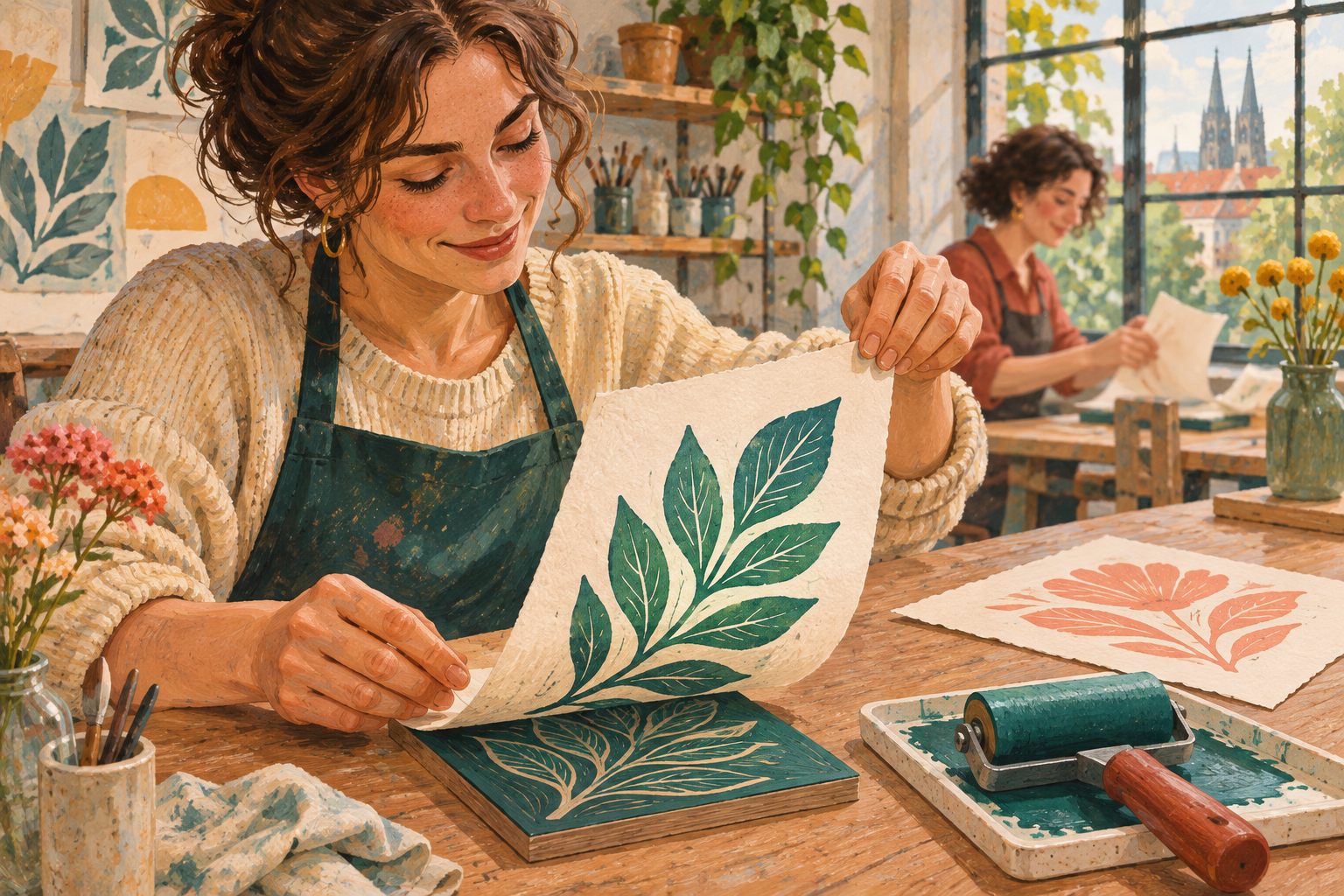
Want to print your own card and looking for a beginner linocut class in Germany? Check how much of the process you will try yourself: transferring a design, carving the block and printing. This guide helps you compare workshops and arrive with a manageable idea.
1. Look for the complete process
Search for “Linolschnittkurs” or “Linoldruck Workshop” and your town. Read the original provider description: does it include designing, carving and printing? Using a ready-made block can be enjoyable, but teaches a different part of the process.
The Ruhr Museum combines its workshop with an exhibition tour and describes making a postcard-sized block. If your priority is practical studio time, check how the session is divided between introductions, the tour and making your print.
2. Match your design to the available time
Bring a simple leaf, cup or abstract shape rather than a detailed street scene. Ask about the size of the block and sketch at that scale before the class. This helps you spot details that are too small. Prepare a simpler alternative as well.
For its introductory group workshop, vectorlab in Chemnitz recommends a design around six by six centimetres, no larger than A6. The session lasts three hours. This illustrates how one provider matches size to time; it is not a duration rule for every studio.
3. Check materials before buying tools
Compare the full cost: the course fee, any material charge and items you need to buy. Ask specifically about carving tools, the block, ink, a roller and paper. Wait to buy a tool set until you know whether you need one and which type works with the instruction.
vectorlab says tools and basic materials are provided. Ask your chosen provider whether this also applies there or whether you need to bring individual items. The examples demonstrate course formats rather than availability on a particular date.
4. Leave time for a test print
Ask whether a first impression and adjustments are part of the session. Spending all your time carving may leave little room for the process you wanted to explore: how does a different application of ink change the result? A small project gives you a better chance to compare papers or colour variations.
Ask the tutor to show how your drawing transfers to the block and which areas will print. Get an introduction to the actual tools before starting. If gripping tools or working at a table for longer periods is difficult, discuss assistance and workspace options with the tutor before booking.
5. What should you bring?
Pack your sketch and clothes that can get ink on them. Follow the provider’s list for aprons, cloths, pencils and paper. Ask how to transport fresh prints: should you bring a folder or a flat support, or collect them later?
Include travel and a break in your plan. For a longer class, ask about food breaks and whether drinks are allowed at the worktable. If attending with a friend, choose individual small designs so each person can work at a comfortable pace.
6. Three questions before booking
Can I join without previous experience? What extra costs or equipment should I allow for? Is there time to make my own block and a test print? Once these are clear, a simple sketch is enough to begin. Use “Explore events” in the eVants event catalogue to look for more creative activities.
Research and image
Original sources checked on 11 November 2026. The examples compare workshop formats; check each provider for dates and terms. The hero image is an AI-generated illustration of a fictional studio.