
Visiting a public observatory: plan for weather, booking and a night at the telescope
Want to look through a telescope? Choose a public observing evening and prepare for the weather, admission and time waiting your turn.
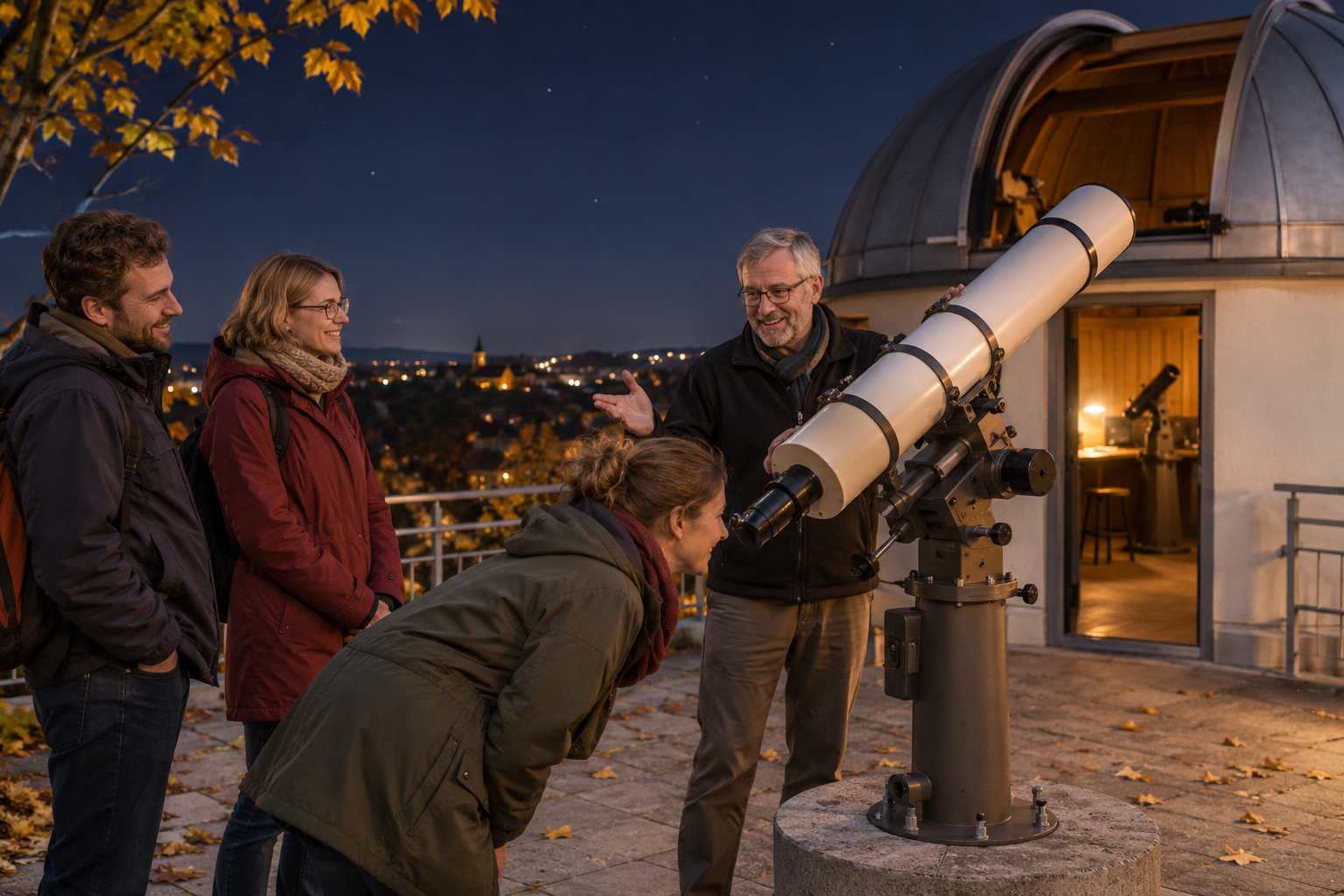
An evening at a public observatory combines a view of the sky with explanations from the people running it. You do not need a telescope of your own to start. What matters is the visitor format and what happens when clouds arrive. This guide helps you choose an observing evening in Germany and ask useful questions before travelling. The three linked institutions are verified examples; their inclusion confirms neither an eVants listing nor available places on a particular date.
1. Choose between observing and a broader guided visit
Search for “Volkssternwarte”, “öffentliche Beobachtung” or “Sternführung” together with your town. Then read the programme: is looking through a telescope the main activity, or are there exhibition rooms, equipment demonstrations and talks too? A planetarium presents a generated sky; telescope observing is directed at the actual sky. Some institutions combine both. The title alone therefore does not tell you what the evening includes.
For example, Munich Public Observatory’s evening tour combines a planetarium presentation with observing through large telescopes when the sky is clear. Advance registration is required there. Before booking, consider whether you would also enjoy the explanations and indoor parts if visibility is poor. If you only want to observe, ask about an offer specifically designed for that and check its conditions.
2. Check the particular observatory’s weather policy
Clouds do not lead to the same decision everywhere. Stuttgart Observatory holds its public night-sky tours only under clear skies. Hamburg Observatory offers a guided tour instead when visibility is poor. Before travelling, check the organiser’s current page and any booking message. A weather app does not replace confirmation that your chosen activity is going ahead.
If you have booked an evening, ask what is provided in cloudy conditions and whether observing on a later date would require a separate booking. A substitute programme does not automatically mean a free return visit. For a longer journey, keep a second leisure plan ready. A café visit or another nearby cultural activity can help fill the evening if the organiser cancels observing.
3. Confirm admission, payment and the meeting point
Check the date, starting time and expected duration directly with the provider. Public visiting sessions are not necessarily the same as a site’s general opening hours. Ask whether everyone starts together, whether late arrival is possible and where the actual entrance is. Save the directions before setting off; a campus can contain several buildings and access points.
For its public observing sessions, the Hamburg page states that advance registration is not required and payment is in cash at the beginning. These conditions belong to that offer. Do not assume other observatories follow them. For your visit, note the booking evidence, payment method and contact details you need. If you plan to attend as a larger group, discuss participation with the organiser beforehand.
4. Plan for clothing, paths and telescope access
Hamburg Observatory points out that its telescope domes are unheated and its historic dome buildings are not accessible without barriers. At your chosen venue, ask specifically about stairs, seating and reaching the eyepiece. An accessible lecture room does not automatically establish access to the observing position. Discuss any assistance you need before making a binding booking where possible.
Dress for standing still at the expected outdoor temperature and choose shoes suitable for the described paths. Keep luggage light. Ask beforehand whether binoculars or cameras would be useful; there is no need to buy equipment simply to take a guided look through the telescope provided. If bringing children, also ask about the intended age group, starting time and breaks.
5. Bring a question and allow time at the telescope
Write down one question before your visit: perhaps how a telescope is aimed, or why an eyepiece view differs from a published astronomical photograph. Let the team explain which objects they will actually show that evening. Do not plan on seeing a particular planet or galaxy solely because it appears in promotional imagery. Visibility and the programme depend on the observing situation.
Let the team explain how to use the equipment and ask before touching any controls or instruments. When people observe one after another, allow time to wait and give others room too. For more ideas for your evening, “Discover events” takes you to the eVants event catalogue. Before travelling, compare an interesting listing with its original source, especially the weather and admission arrangements.
Research and image
Research checked on 6 November 2026. Three original pages were checked afresh; provider features are attributed to the named institutions. The planning tips are editorial recommendations. No specific observing targets or available dates are promised. The hero image is an AI-generated illustration of a fictional observatory, rather than a record of an actual event.